Transition Cow Nutrition
Understanding DCAD and Its Role in Transition Cow Health
How dietary cation-anion difference affects calcium metabolism and milk fever risk around calving, and how to check that your close-up program is actually working.
At calving, a Holstein cow suddenly needs far more calcium than her diet supplies. Colostrum alone carries roughly 2 g of calcium per liter, and the first day's milk can remove more calcium than her entire blood pool holds. To keep up, she has to pull calcium from bone and absorb more from the gut within hours. When those systems are slow to switch on, blood calcium drops. The result is clinical milk fever or, far more commonly, subclinical hypocalcemia. US surveys have found it in close to half of multiparous cows.
Dietary cation-anion difference (DCAD) is one of the most reliable tools we have to help her make that switch in time.
What DCAD measures
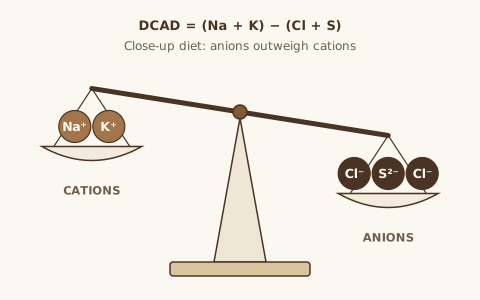
DCAD describes the balance between the strong cations and strong anions in the diet, expressed in milliequivalents per kilogram of dry matter:
To convert mineral analyses reported as % of DM, multiply by these factors: Na × 435, K × 256, Cl × 282, S × 624. A typical dry cow diet built on grass forages easily lands at +150 to +300 mEq/kg DM, mostly because of potassium.
Why a negative DCAD helps
High-potassium diets push the cow toward a mild metabolic alkalosis. Under alkalotic conditions, tissues respond poorly to parathyroid hormone (PTH), the signal that tells bone to release calcium and the kidney to activate vitamin D. The cow has the hormone, but the message doesn't get through.
Feeding a negative DCAD in the close-up period creates a mild, compensated metabolic acidosis. PTH sensitivity is restored, so bone resorption and intestinal calcium absorption are already running when lactation starts. The cow also excretes more calcium in urine before calving, which keeps these pathways active.
The evidence is consistent. In a large meta-analysis, Santos et al. (2019) found that lowering prepartum DCAD reduced the risk of clinical hypocalcemia, retained placenta and metritis, and improved postpartum performance in parous cows. It also caused a modest drop in prepartum dry matter intake.
Getting there in practice
- Control potassium first. Choose low-K forages for close-up cows, such as corn silage, straw and late-cut grass. Anion supplements can't easily offset a ration that starts at +300.
- Add anion sources. Use chloride and sulfate salts or commercial anionic products. Palatability matters, because intake is already falling in the last week before calving.
- Analyze, don't assume. Book values for forage K and Cl are unreliable. Wet chemistry on the actual forages is worth the cost.
- Keep magnesium adequate. Magnesium is needed for PTH secretion and action, so close-up diets are commonly formulated at around 0.4% Mg or more.
Monitoring with urine pH
Urine pH is the cheapest and most direct check that a negative DCAD is working. Sample 8–12 close-up cows after they have been on the diet for at least 2–3 days, at a consistent time relative to feeding, using a mid-stream sample and a calibrated pH meter or narrow-range strips.
| Group-average urine pH (Holstein) | Interpretation |
|---|---|
| > 7.0 | Little or no acidifying effect |
| 6.0 – 7.0 | Partial acidification |
| 5.5 – 6.0 | Fully acidified, the usual target |
| < 5.5 | Over-acidified; risk of reduced intake. Check anion dose. |
Ranges are general guidance; breed and program design shift them slightly.
Look at the spread as well as the average. If a few cows are at 8.0 while others are at 5.2, the problem is usually sorting or inconsistent mixing, not the formulation.
After calving: DCAD flips
Once the cow is lactating, the goal reverses. Positive DCAD in lactation diets, around +350 to +450 mEq/kg DM, supports dry matter intake, milk fat and rumen buffering, especially under heat stress. Feeding anionic salts after calving works against the cow.
Key takeaways
- DCAD = (Na + K) − (Cl + S). Potassium is usually the problem.
- Negative close-up DCAD restores PTH responsiveness and lowers hypocalcemia risk.
- Verify with urine pH weekly; a spread of results points to feeding, not formulation.
- Go back to a positive DCAD immediately after calving.
Selected references
- Santos, J.E.P. et al. (2019). Effects of prepartum dietary cation-anion difference intake on production and health of dairy cows: A meta-analysis. J. Dairy Sci. 102:2134–2154.
- Goff, J.P. (2008). The monitoring, prevention, and treatment of milk fever and subclinical hypocalcemia in dairy cows. Vet. J. 176:50–57.
- Reinhardt, T.A. et al. (2011). Prevalence of subclinical hypocalcemia in dairy herds. Vet. J. 188:122–124.
- Iwaniuk, M.E. & Erdman, R.A. (2015). Intake, milk production, ruminal, and feed efficiency responses to dietary cation-anion difference by lactating dairy cows. J. Dairy Sci. 98:8973–8985.
Educational content. It does not replace individualized veterinary or nutrition consultation.