Rumen Function
Rumen Acidosis: Recognizing the Warning Signs Before Production Drops
Subacute ruminal acidosis rarely announces itself. By the time the bulk tank shows it, the damage started weeks earlier. Here is what to watch for, and how to prevent it through feeding management.
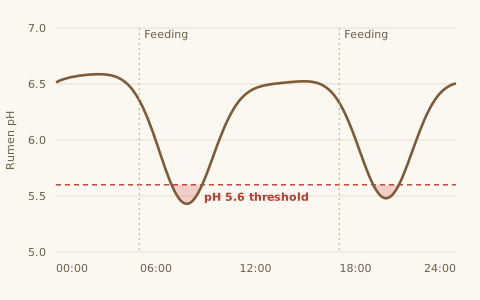
Acute acidosis is easy to spot: a cow that broke into the grain bin is visibly sick. Subacute ruminal acidosis (SARA) is different. Cows keep eating, keep milking, and look mostly normal. Meanwhile, repeated daily dips in rumen pH reduce fiber digestion, damage the rumen wall, and set up laminitis and liver abscesses weeks later.
What SARA is
SARA is usually defined as rumen pH staying below about 5.6 for more than 3 hours a day. Rumen pH naturally falls after each meal as volatile fatty acids accumulate. The problem is when acid production repeatedly outpaces the rumen's buffering and absorption capacity.
At low pH, fiber-digesting bacteria are inhibited, lactate-producing bacteria gain ground, and bacterial endotoxin (LPS) in rumen fluid rises. The rumen wall can then become inflamed and more permeable, which lets bacteria and LPS into the bloodstream. This is the likely link to liver abscesses and laminitis.
The usual causes
- Too much rapidly fermentable carbohydrate: high starch, finely ground or highly processed grain, high-moisture corn, or more fermentable silage after months in storage.
- Too little effective fiber: low forage NDF, or forage chopped too short to stimulate chewing and saliva.
- Sorting: cows eat the concentrate first and leave the long particles, so the diet they actually eat is hotter than the one formulated.
- Slug feeding: empty bunks, overcrowding, or irregular feeding times lead to fewer, larger meals.
- Abrupt transitions: fresh cows moved from a high-forage dry diet straight onto the full lactation ration.
Warning signs, before the milk drops
No single sign is diagnostic. Look for several of these appearing together at group or herd level.
| Where to look | What you may see |
|---|---|
| Feed intake | Day-to-day swings in group DMI; cows going off feed for a day, then recovering |
| Rumination | Fewer than about half of resting cows chewing cud; falling rumination minutes on activity collars |
| Manure | Loose, inconsistent, bubbly manure; visible undigested fiber and grain; variation between cows on the same ration |
| Milk | Falling milk fat, and more early-lactation cows with fat % below protein % |
| Feet | Sole hemorrhages and ulcers appearing weeks to months after the event |
| Culling | More unexplained losses, and liver abscesses found at slaughter |
Milk fat depression deserves a caution. It is common with SARA, but its direct cause is altered fatty-acid biohydrogenation in the rumen. Unsaturated fat and ionophores can produce it without SARA, so treat it as a flag, not a diagnosis.
Prevention through feeding management
Ration
- Keep adequate fiber. NRC (2001) sets minimums of around 25% NDF and 19% forage NDF in DM, and many high-producing rations sit above these.
- Match starch level and fermentability. Rations commonly run about 24–28% starch in DM, but ensiled high-moisture grain and finely processed corn need a lower ceiling.
- Supply physically effective fiber. Use the Penn State Particle Separator to check the TMR, and don't over-process forage.
- Use dietary buffers such as sodium bicarbonate, typically around 0.75% of DM. A positive DCAD in lactation diets also helps.
Bunk and barn
- Mix consistently. Check load order, mixing time and TMR moisture, especially after forage changes.
- Keep feed available. Push up feed frequently and aim for small refusals so the bunk is never empty.
- Avoid overcrowding at the bunk and in the stalls. Crowded cows eat fewer, larger meals.
- Step fresh cows up gradually. A fresh-cow ration or transition step lets the rumen papillae and microbes adapt.
- Monitor sorting by comparing particle distribution in fresh TMR and refusals.
Key takeaways
- SARA is a herd problem that shows up in intake swings, rumination and manure before it shows in milk.
- Most cases come from a gap between the ration on paper and the ration the cow actually eats.
- Fiber, starch fermentability, buffering and bunk management all matter. Fixing only one rarely solves it.
Selected references
- Plaizier, J.C. et al. (2008). Subacute ruminal acidosis in dairy cows: The physiological causes, incidence and consequences. Vet. J. 176:21–31.
- Garrett, E.F. et al. (1999). Diagnostic methods for the detection of subacute ruminal acidosis in dairy cows. J. Dairy Sci. 82:1170–1178.
- Krause, K.M. & Oetzel, G.R. (2006). Understanding and preventing subacute ruminal acidosis in dairy herds: A review. Anim. Feed Sci. Technol. 126:215–236.
- National Research Council (2001). Nutrient Requirements of Dairy Cattle, 7th rev. ed.
Educational content. It does not replace individualized veterinary or nutrition consultation.